The Stranded Value Problem
Everyone's obsessed with what AI can produce. Are they measuring what they can realistically absorb?

There’s a growing gap between what AI systems can produce and what organizations can realistically absorb.
Most companies are focused on the first problem. Fewer are measuring the second.
Every organization has a practical limit to the amount of operational change it can absorb at one time. That limit is shaped by coordination costs, decision-making structures, technical dependencies, staffing, governance, incentives, and institutional inertia.
The constraint becomes visible during periods of concentrated change. A company can usually absorb a handful of major initiatives simultaneously: a platform migration, a workflow redesign, a pricing change, a reorganization, a new operating model. Beyond a certain point, execution quality begins to degrade. Teams compete for the same operational bandwidth. Dependencies accumulate faster than they can be resolved. Coordination overhead increases. Priorities become unstable.
AI increases pressure on this constraint because the rate of potential capability expansion is accelerating faster than most organizations can operationalize change.
That creates a widening gap between technical capability and operational adoption.
I refer to that gap as stranded value.
The term describes unrealized value: capabilities that exist technically but have not yet been integrated into systems, workflows, decision-making processes, or organizational behavior.
Below is a simplified model of the idea.
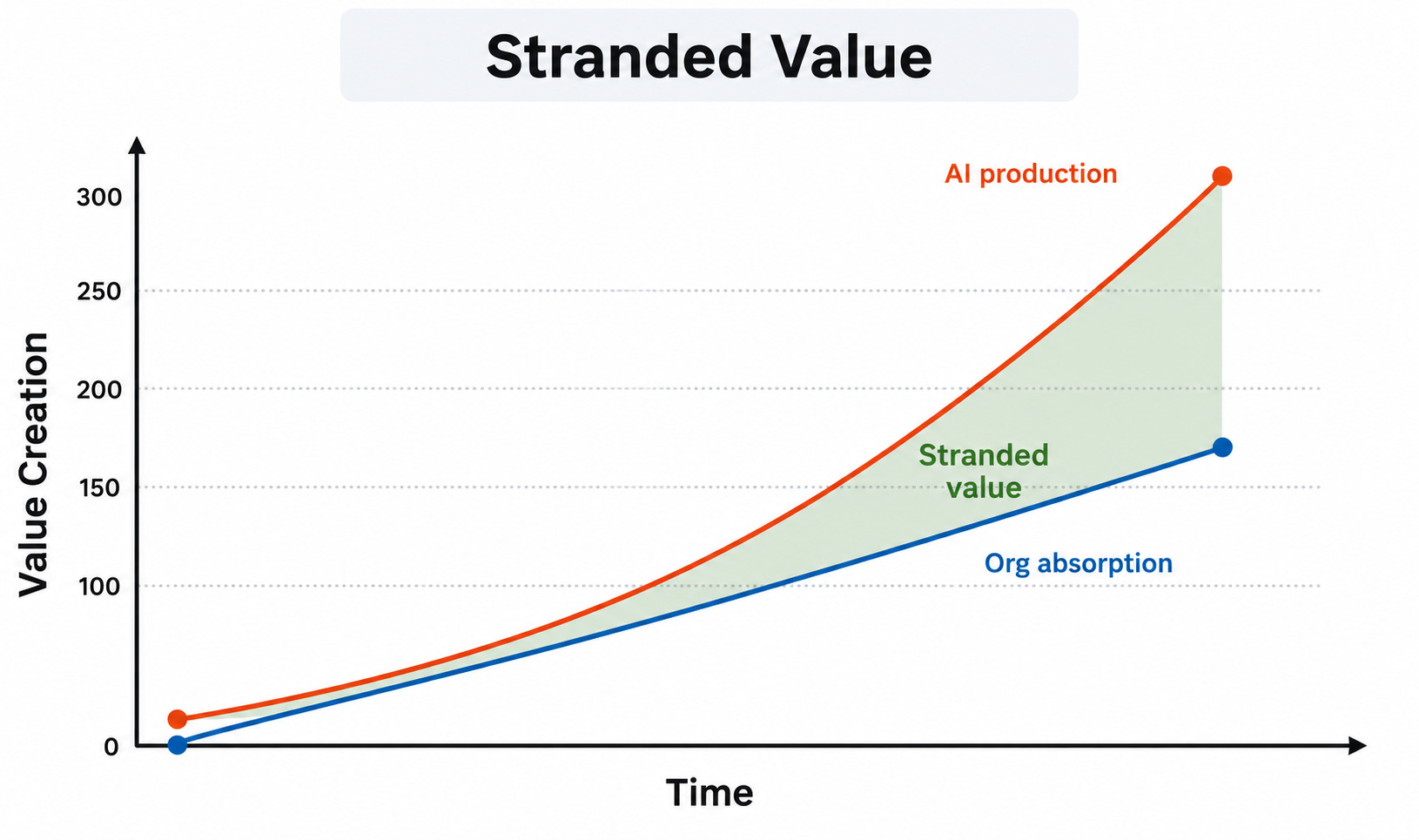
The upper curve represents expanding AI capability. The lower curve represents organizational absorption capacity: the rate at which an organization can safely integrate and operationalize change.
The shaded area between them represents the accumulation of stranded value.
This dynamic is easy to misdiagnose. When AI initiatives fail to scale, organizations often attribute the problem to model quality, implementation mistakes, or insufficient experimentation. Those factors matter, but they are not always the primary constraint.
In many cases, the organization has reached a saturation point where the limiting factor is no longer technical capability, but institutional capacity to absorb additional change.
That distinction matters because the response changes depending on where the bottleneck actually exists.
If the constraint is technical, the solution is better models, tooling, or infrastructure.
If the constraint is organizational, the solution is different. It involves reducing coordination overhead, improving decision velocity, clarifying ownership structures, sequencing change more deliberately, and increasing the organization’s ability to operationalize new capabilities without destabilizing existing systems.
Organizations will vary significantly in how effectively they can do this. Some will accumulate large amounts of stranded value without ever converting it into operational advantage. Others will systematically improve their capacity to absorb change and compound gains over time.
As AI capability continues to accelerate, that difference may become increasingly important.