The Seams Between Teams
How end-to-end product, service, and experience thinking fortifies competitive edge.

Customers don’t experience a company the way it’s drawn on a strategy slide. Customer journeys or only as good as the org chart underneath them and the handoffs or gap management those orgs manage.
That confusing onboarding flow? It might be the result of Legal minimizing risk, Product optimizing adoption, Engineering working around a legacy system, and Support compensating for all of it.
To the customer, none of that matters. It feels like one experience.
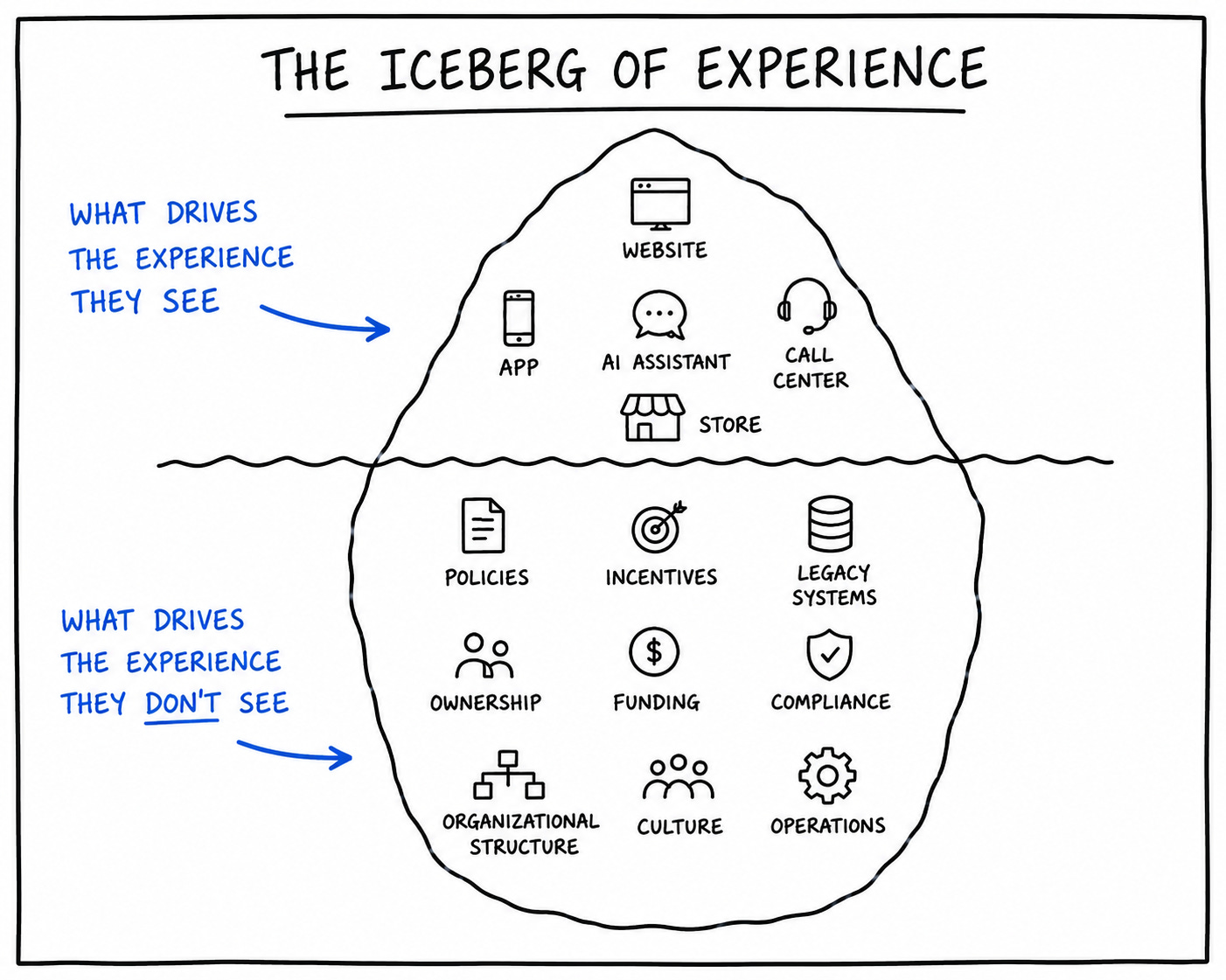
This is where service design and strategic end-to-end user research earn their seat at the table.
Why?
Because our experiences have become dramatically more complex. And they continue to expand.
Every year organizations add more features, more channels, more personalization, more AI, more automations, more integrations, and more ways to accomplish the same task. Building has become easier than ever. Deciding what not to build has become much harder.
The result is a world filled with capable products that are increasingly difficult to understand, navigate, and maintain. Complexity compounds. Every new feature creates another decision. Every new workflow introduces another dependency. Every optimization for one team becomes another point of friction for someone else.
This isn’t a criticism of product teams. It’s the natural outcome of organizations that are rewarded for shipping real value.
The challenge is no longer building software.
The challenge is preserving coherence, continuity, and cognition.
That is the work of service design. It starts with a different set of questions.
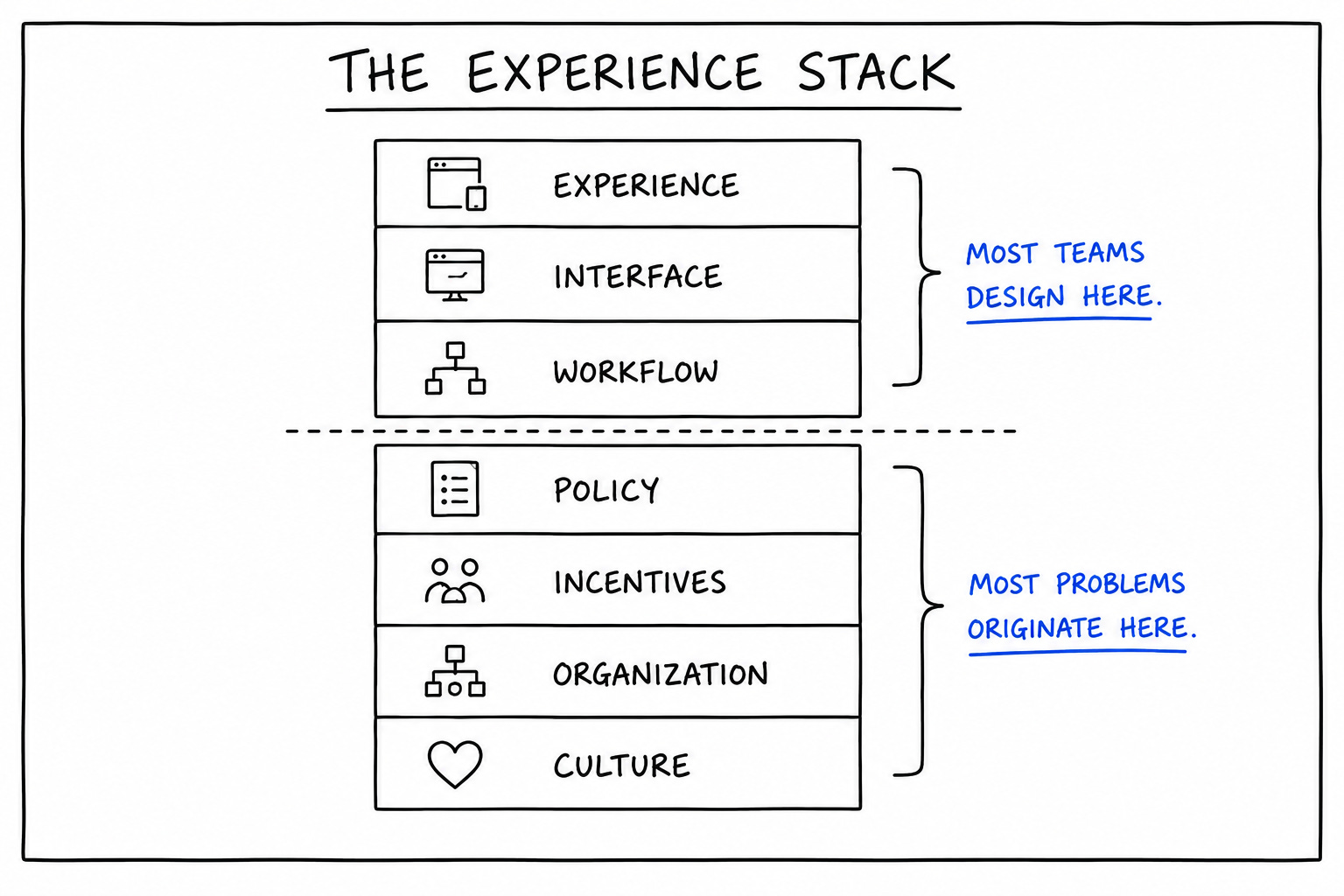
What has to change inside the organization to make a better experience possible?
Which organizational assumptions are quietly shaping this experience today?
Where does value break down as work moves from one team to another?
If this experience were designed from scratch today, what would never be built this way in the first place?
Instead of focusing exclusively on interfaces, service design examines continuity across teams, policies, incentives, processes, systems, and operations. It recognizes that many customer problems are organizational problems that simply happen to surface in customer-facing moments.
Some thoughts on what to do about it for different practitioners.
🎨 UX Designers
When the same feature gets redesigned repeatedly, the interface usually isn’t the limiting factor. Repeated friction is often evidence that a policy, process, ownership gap, or incentive is recreating the problem faster than any solution can solve it.
Great experiences begin before the screen and continue after it. Looking upstream and downstream uncovers dependencies customers experience every day but no single product team owns. That broader perspective is what preserves coherence across the entire experience instead of optimizing isolated moments.
Design creates leverage when it exposes invisible constraints. Reducing friction is valuable. Helping the organization understand why that friction exists is what creates lasting change.
📦 Product Managers
Recurring customer pain is often organizational misalignment made visible. Some of the most persistent problems don’t belong in a sprint because they don’t belong to one team. They live between teams, roadmaps, and competing priorities.
Some of the highest-impact opportunities exist where ownership is unclear. The best product managers become connectors across functions. Preserving continuity between teams often creates more customer value than shipping another isolated capability.
Instead of saying, “We already knew that,” ask, “Why does everything else we know not show up in this report?” Research rarely succeeds because it uncovers something no one has ever heard before. The scientific process starts with observation. Its real value is validating assumptions, revealing contradictions, surfacing blind spots, and helping organizations prioritize evidence over opinion.
🧭 Service Designers
Journey maps and service blueprints are not the product. Shared understanding is. Their value comes from helping organizations see the system they collectively created, often for the first time.
Translate experience work into organizational outcomes. Delivery speed, operational efficiency, employee effectiveness, customer retention, cost to serve, and resilience are outcomes leaders already care about.
Influence grows by connecting customer experience to organizational design. The most effective service designers help leaders understand how decisions made inside the organization ripple outward into customer experience. Solving problems at their source preserves continuity across the entire service instead of treating symptoms one interaction at a time.
🔬 Researchers
Listen carefully for breakdowns between touchpoints. Phrases like “I had to call someone,” “They told me something different,” “I got transferred,” or “I had to figure it out myself” often reveal more about the service than any usability finding.
Follow the story, not just the discussion guide. Asking what happened before, what happened after, and sketching the journey together helps reconstruct the experience as it actually unfolded. Those transitions are often where the most valuable insights live.
Look beyond what participants did. Look also at what the organization required them to do. Handoffs, duplicated work, conflicting information, invisible actors, and workarounds reveal how the service actually functions. Policy describes what should happen. Human behavior reveals what actually happens. The gap between the two is often where the biggest opportunities are found.
The most valuable research findings often aren’t about users alone. They’re also about an organization’s current mental model. The assumptions people carry from meeting to meeting, project to project, and decision to decision rarely reflect the totality of what is documented. Those assumptions quietly shape every experience the organization creates.
Organizations will continue adding capabilities. They should.
The differentiator won’t be who builds the most.
It will be who preserves coherence as experiences expand, continuity as work moves between teams, and cognition as organizations become more complex.