Have Your Agent Call My Agent
How AI agents may reshape markets—and the questions researchers ask.


For decades, the phrase “Have your agent call my agent” belonged to celebrities, athletes, executives, and the exceptionally wealthy.
They employed agents because their time became too valuable to negotiate every contract, evaluate every opportunity, or field every request themselves. Representation was a luxury. If you had an agent, it usually meant you’d reached a level of success where someone else’s full-time job was maximizing your own.
I don’t think that’s going to remain true.
An evolving model
The more I’ve thought about AI agents over the past few months, the less interested I’ve become in their ability to summarize documents, book travel, or answer emails. Those are useful capabilities, but they all share the same assumption: that an agent is fundamentally an assistant.
I’m beginning to wonder if that’s an outdated mental model for the future.
Historically, assistants helped you execute work. Representatives helped you navigate markets and opportunity.
Those are very different jobs.
The latter is far more interesting because an enormous percentage of our lives is really just a series of negotiations. We negotiate salaries, mortgages, insurance premiums, consulting contracts, home purchases, medical bills, investment decisions, and countless smaller transactions that quietly compound over time. Every one of those interactions involves another person or organization attempting to optimize for its own interests. Sometimes those interests align with ours. Often they don’t.
Until now, the only real solution was to become an expert yourself or hire someone who already was.
AI introduces a third possibility.
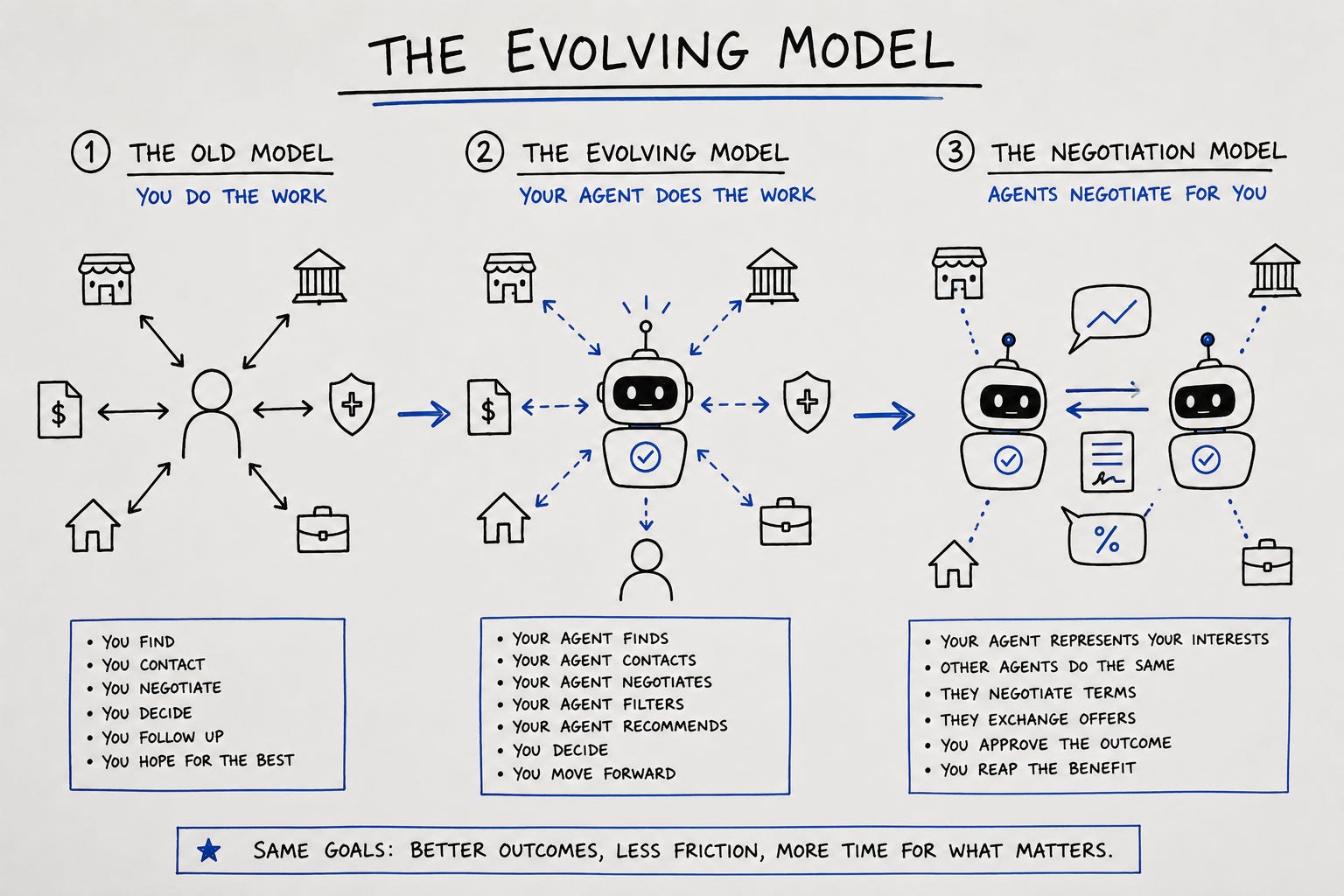
Instead of simply helping you complete tasks, an agent could increasingly represent your interests. It could understand your financial goals, your appetite for risk, your schedule, your preferences, and your long-term objectives well enough to negotiate on your behalf.
That’s when that old Hollywood phrase starts sounding surprisingly practical.
“Have your agent call my agent.”
Imagine the scenarios for a minute:
Job: Your career agent reaches out to a company’s hiring agent before you’ve even seen the job posting.
Purchasing: Your buying agent negotiates with seller agents across dozens of marketplaces before presenting you with three recommendations.
Health: Your healthcare agent coordinates appointments, challenges billing errors, and compares treatment options long before you receive a notification on your phone.
Independence: Your consulting agent identifies opportunities that match your expertise while politely declining work that doesn’t.
Notice what changes.
The interaction is no longer primarily between a person and a business. Increasingly, it’s between representatives acting on behalf of people and businesses. Humans don’t disappear from the equation, but they stop participating in every transaction. Instead, they step in when judgment, ethics, or personal values require a human decision.
If that sounds speculative, consider how much decision-making we’ve already delegated.
Navigation software chooses our routes.
Spam filters decide which emails deserve our attention.
Investment platforms automatically rebalance portfolios.
Recommendation engines influence what we watch, buy, and listen to.
We’ve been outsourcing decisions for years. Agents simply extend that delegation into markets that have historically required direct human participation.
Research community implications
If this trajectory is even directionally correct, I think it has meaningful implications for the research and strategy communities.
For decades, we’ve invested enormous effort in understanding how people make decisions. We’ve developed an impressive toolkit for studying preferences, behaviors, mental models, and tradeoffs. Those methods don’t suddenly become obsolete, but I do think the questions they answer begin to evolve.
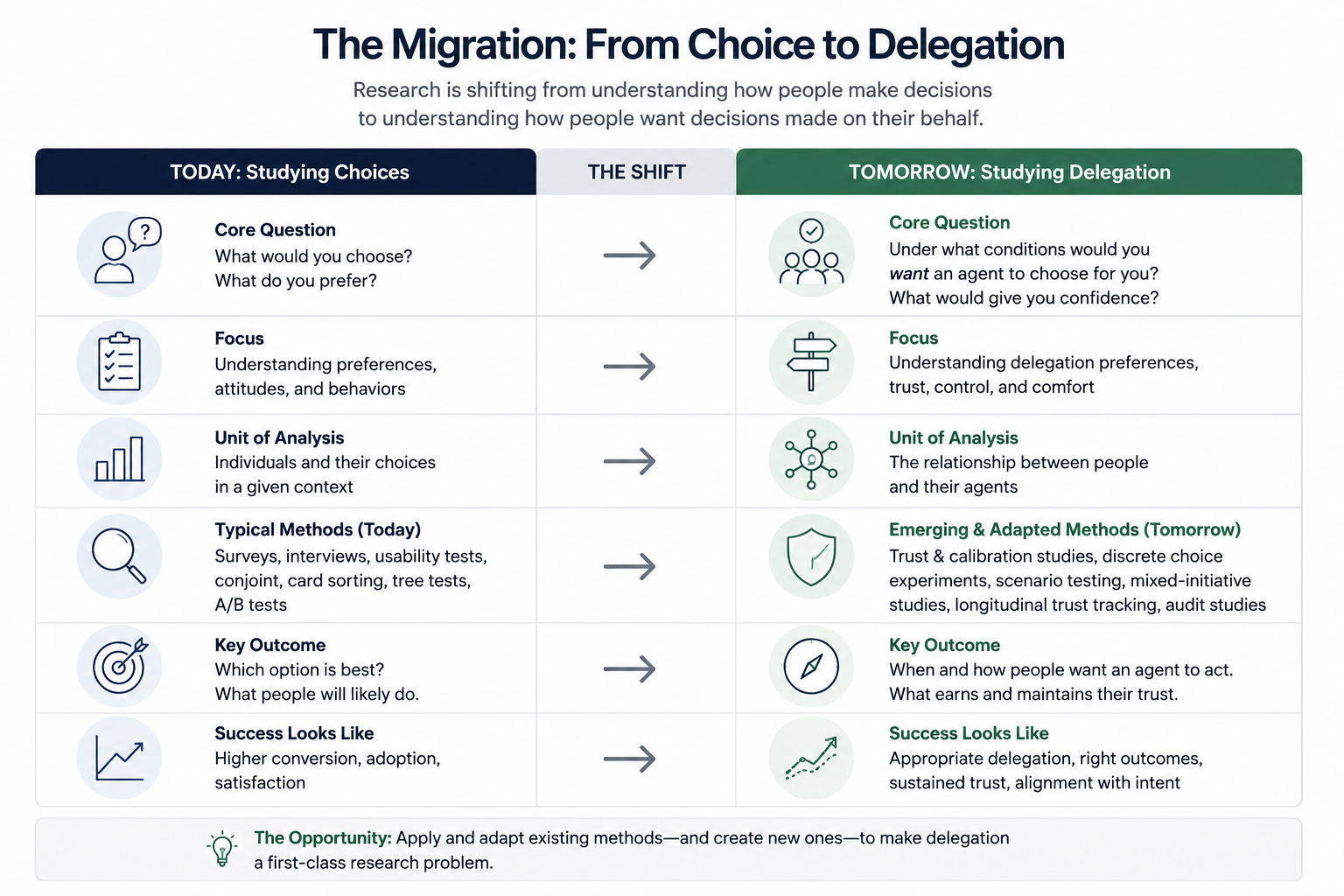
The visual above illustrates what I mean. Much of today’s research asks questions like: What would you choose? Which option do you prefer? What factors influence your decision? Increasingly, I suspect we’ll ask a different class of questions: Under what conditions would you want an agent to choose for you? How much authority are you willing to delegate? When should an agent interrupt you? When should it simply act?
That’s a subtle shift, but an important one.
The opportunity isn’t to throw away our existing methods. It’s to adapt them. Conjoint analysis, trust research, longitudinal studies, human-AI interaction, and decision science already provide many of the building blocks. The challenge is applying them to a new problem: not understanding choice itself, but understanding delegation. In other words, the unit of analysis begins to move from individual decisions to decision policies.
That may sound like a subtle distinction, but I don’t think it is. It reflects a broader shift in how we think about AI itself. For years we’ve framed AI primarily as a productivity tool—a way to help people work faster, write better, or make slightly better decisions. Representation suggests a different future entirely. Instead of helping us make decisions, AI increasingly begins making decisions in our interest.
Today we assume AI agents will be another software subscription. They’ll cost money because that’s what software does. We pay for tools that make us a little more productive. I’m not convinced that’s where this story ends.
At some point, the expectation shifts. Your agent is no longer judged by how many hours it saves. It’s judged by whether it creates more value than it consumes.
Did it negotiate a better mortgage?
Recover money you didn’t know you were owed?
Find a consulting engagement that otherwise would’ve never appeared?
Reduce unnecessary spending or negotiate a contract you would’ve accepted too quickly?
Eventually, the conversation isn’t about whether the subscription is worth the monthly fee. It’s about whether your representative is earning its keep.
That feels like a much more profound shift than giving everyone a digital assistant.
For most of history, meaningful representation was reserved for people whose opportunities justified the expense of hiring someone to advocate on their behalf. AI may ultimately democratize something much larger than productivity.
It may democratize representation itself.
And if that happens, “Have your agent call my agent” won’t be a joke or a status symbol.
It’ll simply be how we connect, negotiate, and do business together.